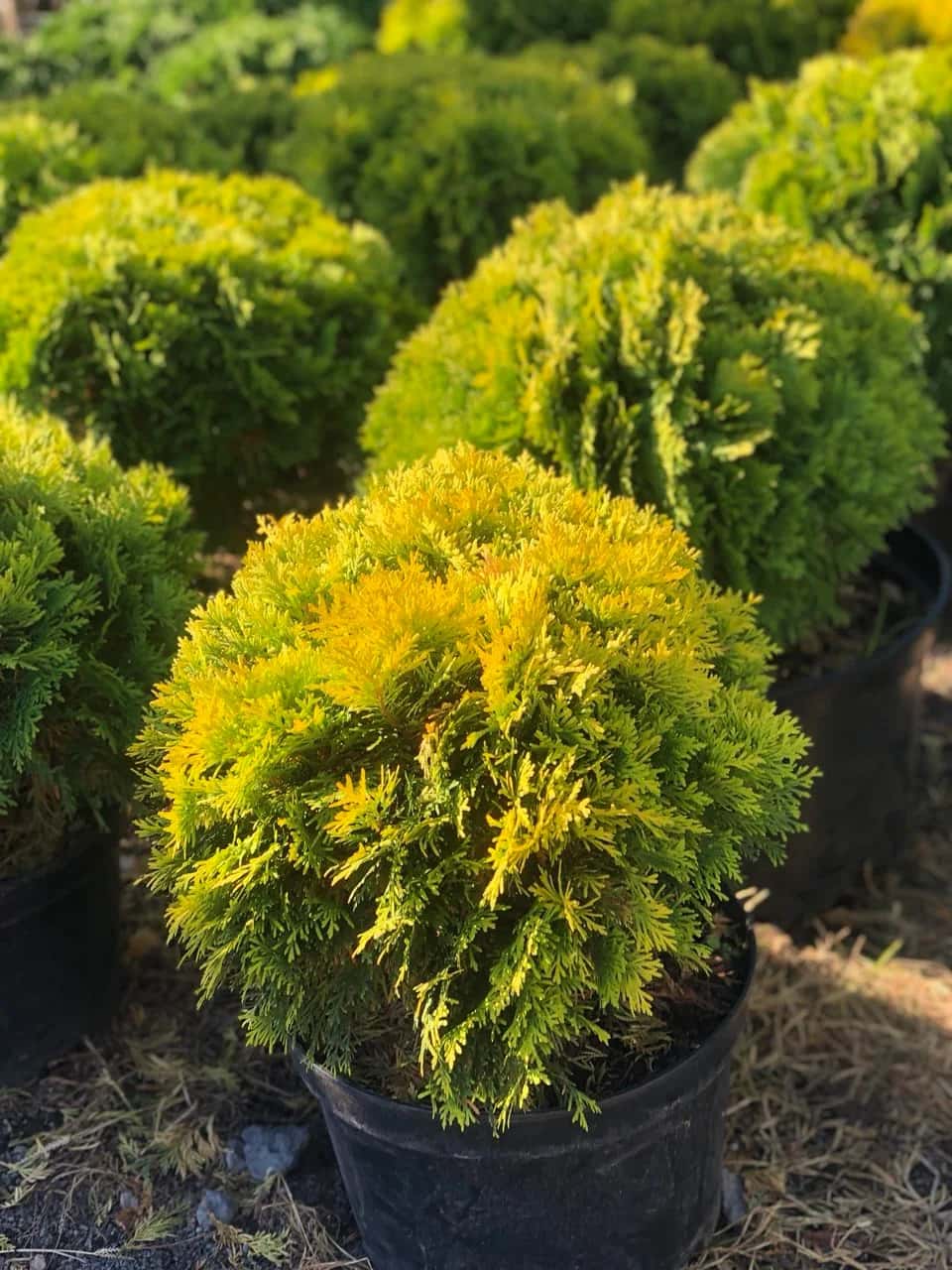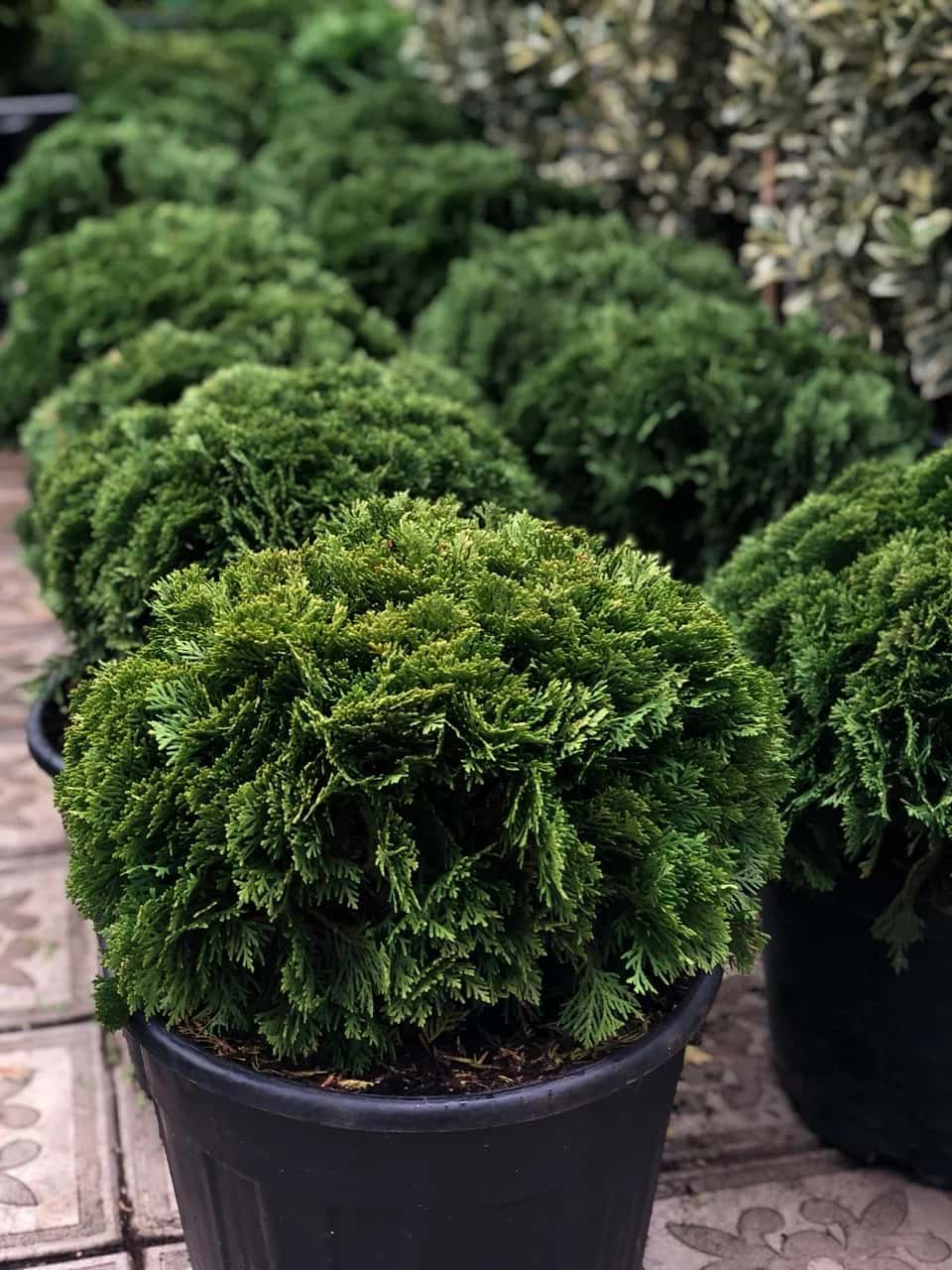
Globular thuja: Danica or Mirjam for a small garden?
Compare Danica and Mirjam thujas by colour, shape and position in the garden. Choose spacing and learn what to consider for a terrace or border.
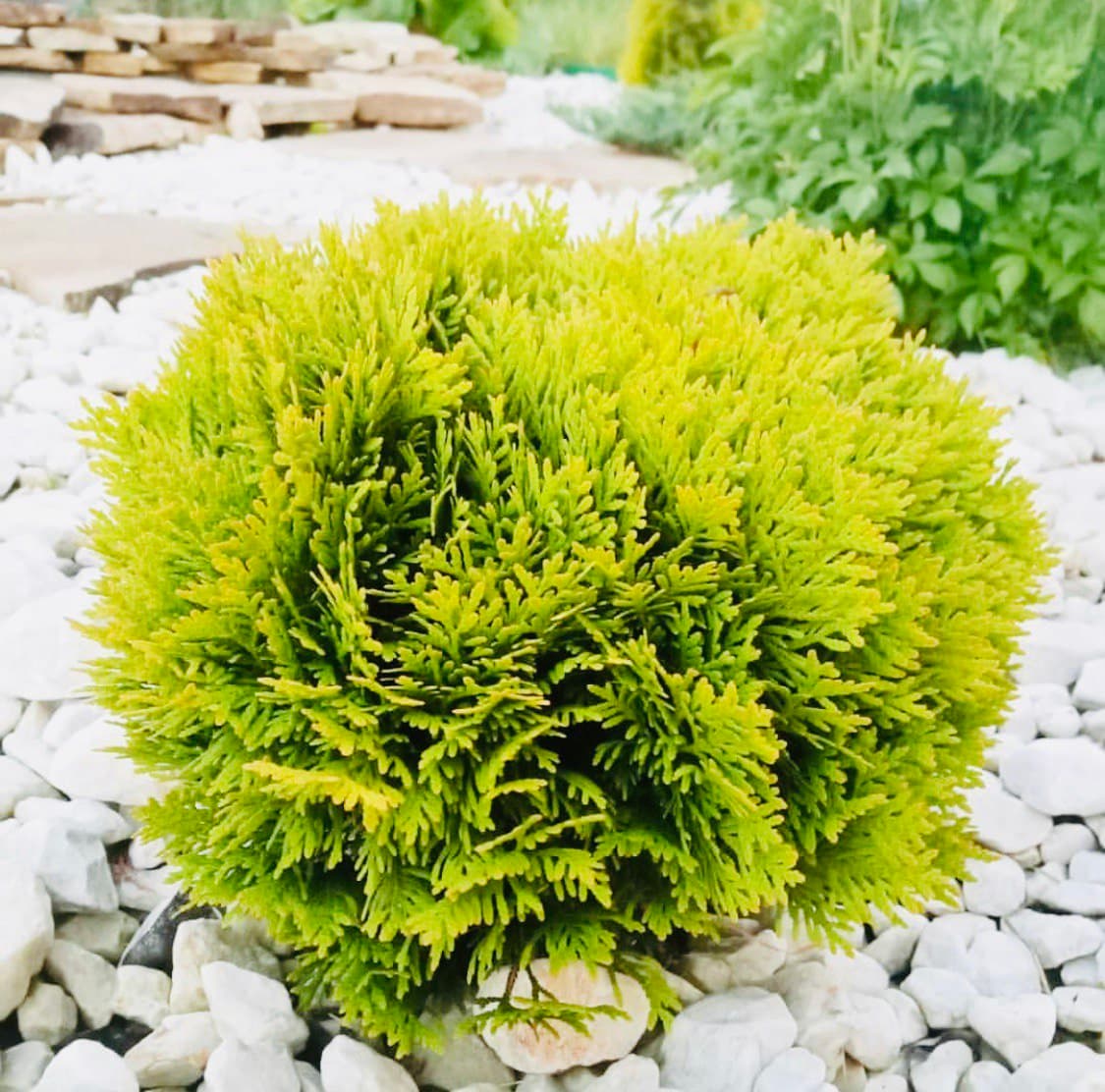
For a calm green accent, consider Danica. For a golden-yellow touch, compare Mirjam. Both thujas have rounded forms worth considering for a small garden. The choice starts with available space and site conditions, rather than a photograph alone.
If you are preparing an autumn border, you have probably seen terms such as “globular thuja”, “dwarf thuja” or “round thuja”. They describe appearance but do not replace the cultivar name. Two similar plants in pots can develop different colours and proportions over the years.
Danica: for a structured green planting scheme
The Royal Horticultural Society (RHS) describes Thuja Danica as a dwarf, slow-growing conifer with a dense globular crown and bright green foliage. It may take on bronze tones in winter. Source: RHS entry for Danica.
As a design option, repeat it along a path or use a small group beside a terrace. Repeating one cultivar creates a simple visual rhythm. Before ordering several plants, mark their intended positions and view the arrangement from both the entrance and a window.
Mirjam: for a golden accent
Thuja Mirjam has a compact rounded form and green foliage with golden-yellow tones. Its colour may become orange-bronze in autumn and winter. This seasonal characteristic is described in the RHS entry for Mirjam.
For garden design, we suggest using it as an accent beside predominantly green planting or a neutrally coloured path. If there is already plenty of colourful foliage, sketch the arrangement first: one accent may be enough in a small space.
A catalogue photograph captures a particular moment in the year. September colour need not match midwinter colour; keep this in mind when comparing cultivars.
What should you check before choosing?
- Light and soil. The RHS entries specify sun and good drainage for both cultivars. Danica needs soil moisture, and young plants benefit from protection against drying winds. Check the site after rain and plan access for watering.
- Future size. The height of the specimen on sale is not its final size. Ask separately about current dimensions and expected cultivar development. Do not plan the space using pot width alone.
- The effect you want. For a row of green forms, start by comparing Danica. For colour contrast, consider Mirjam. These are design ideas, not fixed rules.
- The purpose of the planting. A low border and a privacy screen are different projects. For a tall boundary, start with the height you need and explore other forms in the conifers category.
How far apart should you plant globular thuja?
Start with the expected future crown width and the gap you want between plants. For two specimens of equal width, the centre-to-centre spacing equals the expected width plus the desired clear gap.
For example, if your design uses a width of 80 cm and you want 20 cm between crowns, the centres will be 100 cm apart. This illustrates the calculation; it is not a guaranteed size for Danica or Mirjam. Beside a path, allow space for passage and maintenance.
Can they grow in a pot on a terrace?
The RHS lists container growing among the uses for both cultivars. Choose a pot suited to the root ball, with drainage holes, and plan to replace it as the plant develops.
Container plants lose water faster than plants in the ground. Check moisture even in cold weather, without leaving the growing medium waterlogged. Roots close to a pot's walls are more exposed to frost, so container placement and protection matter. Source: RHS — trees and shrubs in containers.
If you are planting this autumn
After choosing a cultivar, check timing and site preparation in When should you plant thuja? An autumn guide for Moldova. It covers planting steps and guidance for watering afterwards.
Compare available specimens on the Danica and Mirjam pages. Check prices and variants directly in the catalogue. If you need help with garden design, everleaf services are agreed through an individual quote. Use the contact page to share your locality, plot dimensions and a few photographs of the site.